Algho Product Sheet
1. Platform Overview
1.1 What is Algho
Algho is an enterprise-grade AI Conversational Ecosystem developed by QuestIT, an Italian technology firm specialised in proprietary Artificial Intelligence research and product engineering. The platform combines a portfolio of in-house AI components — natural language processing, vector embeddings, retrieval-augmented generation, speech technologies, real-time avatar animation and an LLM-agnostic inference layer — into a unified, no-code environment for the creation, governance and orchestration of specialised AI Agents and Digital Human experiences.
At its core, Algho is designed to deliver multimodal, context-aware interactions across every customer touchpoint, while remaining open and extensible toward third-party Large Language Models, enterprise systems of record and on-premise data sources. The platform addresses the full spectrum of enterprise conversational AI: customer-facing agents, employee productivity agents, document intelligence applications, decision-support tools and proactive outbound engagement.
Algho operates as a layered platform: external channels normalise into a single Conversation API, business actions are exposed as structured forms and tool calls, knowledge is grounded on curated corpora through the Smart Document Access subsystem, and an integration plane connects every flow to the enterprise systems that already run the business. The result is a platform that is API-first, action-capable, governable and ready to be operated under formal enterprise controls.
From a commercial standpoint, Algho is offered through three delivery models — multi-tenant SaaS on cloud, customer-managed On-Premise installation and a fully integrated hardware-plus-software Appliance. The same product capabilities are available across all three delivery models, allowing customers to choose the security and sovereignty posture that best fits their regulatory and operational environment.
1.2 Functional Pillars
The product is structured around five functional pillars that collectively define the scope of Algho. These pillars are the lens through which features, use cases and roadmap items are evaluated.
- AI Orchestration — design, deployment and governance of specialised AI Agents capable of analysing user intent, delegating subtasks to other agents, retrieving information from enterprise systems and executing controlled actions autonomously.
- AI Decision Intelligence — conversational access to structured business data. Users can ask questions in natural language and receive real-time KPIs, trends and dynamic visualisations without writing SQL or navigating a BI tool.
- AI Automation — execution of business workflows directly from a conversation: approvals, ticketing, system updates, escalations and end-to-end processes orchestrated via the Workflow Builder with hundreds of pre-built connectors.
- Intelligent Document Processing (IDP) — ingestion, parsing, paragraphisation and semantic indexing of unstructured documents. OCR/ICR pipelines convert paper, PDF and form data into structured, queryable knowledge accessible through conversation.
- Bundles — ready-to-use solutions tailored to 7 different business areas and four vertical platforms (Supply Chain, XR, Decision, Sales Assistant) that integrate Algho into specific business functions, drastically reducing the time to return on investment..
1.3 High-Level Logical Model
Algho is architecturally organised as five cooperating planes. Each plane has a clear responsibility and a stable contract with the adjacent plane, enabling modular evolution, polyglot internal implementations and clean enterprise governance.
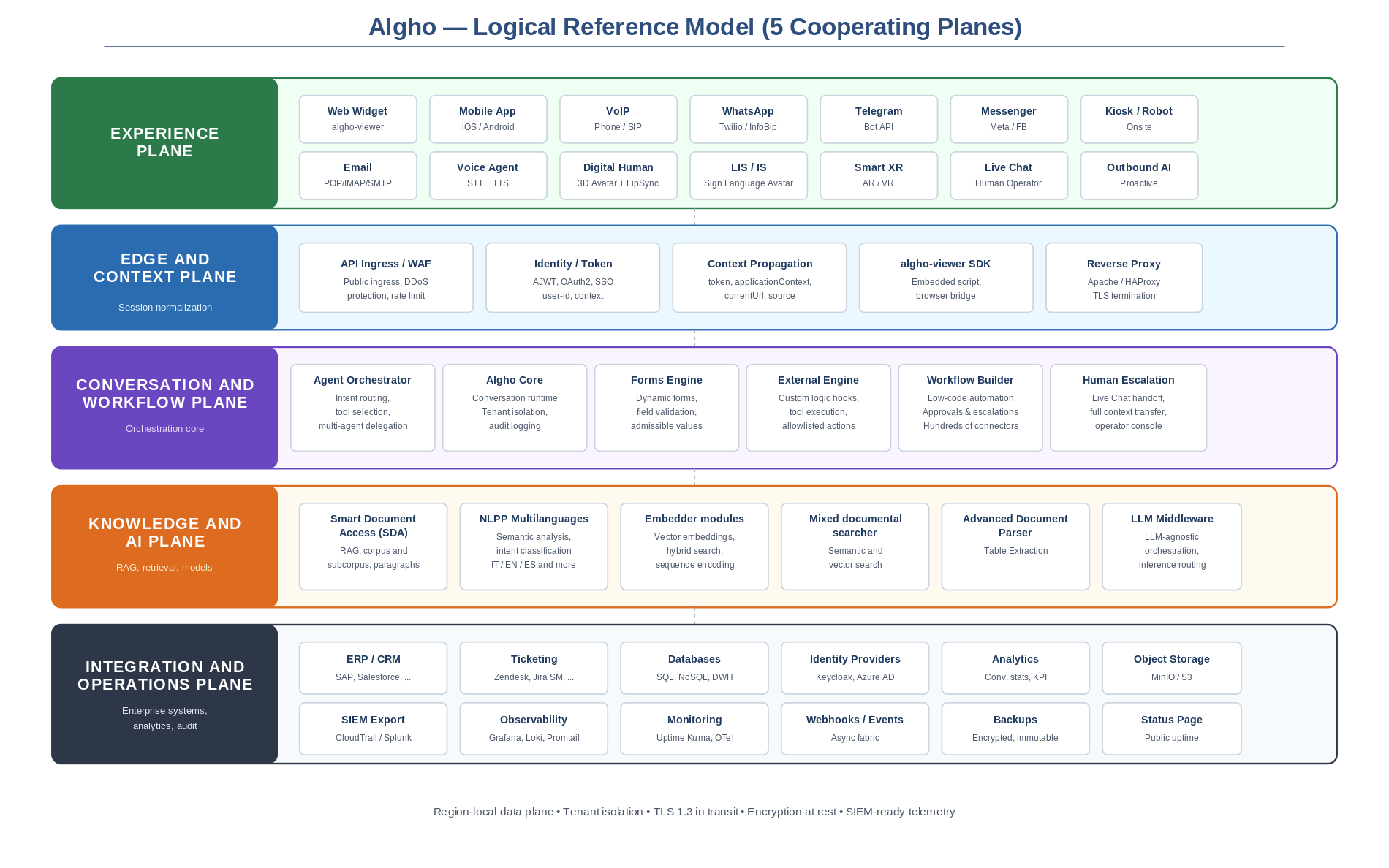
Figure 1 — Algho logical reference model: five cooperating planes.
- Experience Plane — every public interaction surface, including web widget, mobile app, voice, VoIP, WhatsApp, Telegram, Messenger, email, kiosk, digital-human and Smart XR endpoints.
- Edge & Context Plane — client integration, session normalisation, identity propagation and API ingress. This is where AJWT tokens, user-id and applicationContext become first-class inputs to the conversation core.
- Conversation & Workflow Plane — orchestration of dialog state, forms, external actions, tool invocation and human escalation. This is the runtime that decides whether a request is answered through workflow, retrieval, form, external engine or a live operator. The Agent Orchestrator is the dedicated component that performs intent routing, tool selection and multi-agent delegation.
- Knowledge & AI Plane — Smart Document Access, semantic and vector retrieval, model routing and generation. This plane hosts the NLPP Multilanguages engines, the Embedder modules, the Mixed Documental Searcher and the LLM Middleware that exposes the underlying LLM-agnostic inference layer.
- Integration & Operations Plane — connectors to enterprise systems (ERP, CRM, ticketing, IdP, databases), analytics, audit, observability and security telemetry. This is the layer that makes Algho operable under enterprise IT and security standards.
1.4 Priority Use Cases
The platform has been validated across a broad range of operational and customer-facing scenarios. The table below summarises the use cases that constitute the typical engagement footprint of an Algho deployment.
| Use case | Description |
|---|---|
| Customer Support | Automated, multilingual handling of FAQs, complaints, billing inquiries, bookings and ticket triage across web, voice, VoIP, WhatsApp, messaging and kiosk channels, with intelligent escalation to human operators. |
| Operations & Maintenance | Field-support agents providing up-to-date procedures, spare-part availability and troubleshooting guidance, reducing intervention times and standardising operational quality. |
| Decision Intelligence | Natural-language access to KPIs and reporting data from SQL, ERP and CRM systems, enabling non-technical users to interrogate business performance in real time. |
| Human Resources | CV screening, onboarding, training and internal request management, reducing hiring time and enhancing the candidate experience through 24/7 conversational HR services. |
| Marketing | AI Avatars as brand ambassadors, automated lead qualification, campaign management and conversational landing-page experiences that increase engagement and conversion. |
| Supply Chain | Real-time monitoring of orders, shipments and inventories; supplier management and demand forecasting in conversational form. The use case extends to information extraction from unstructured documents — transport documents, invoices, delivery notes, customs declarations and supplier catalogues — with their structured digitalisation: extracted fields are normalised, validated and pushed into the customer ERP, WMS or accounting systems, replacing manual data entry and enabling end-to-end traceability. |
| Document Intelligence | Conversational interrogation of large enterprise knowledge bases — manuals, contracts, regulations, technical documentation — grounded on verifiable sources through RAG and IDP pipelines. |
1.5 Industries Served
Algho is sector-agnostic by design, but has developed pre-configured templates and reference deployments across the following industries:
- Finance — document validation, request automation, conversational data analysis.
- Utilities — multi-channel customer support for billing, meter readings, ticketing and
- complaints.
- E-commerce — purchase support, order tracking, promotion management, cartabandonment recovery.
- Healthcare — intelligent booking, informed-consent management, clinical
- documentation, pre- and post-operative support.
- Public Administration & Culture — digital service desks, event booking, inclusive
- citizen access (including LIS Sign Language Avatar).
- Industrial & Transportation — operations and maintenance support, technical
- documentation interrogation, spare-parts logistics.
- Marketing & Sales — lead generation, automated outreach, proactive follow-up.
- Customer Service — 24/7 omnichannel support, intelligent escalation, ticket lifecycle
- management.
- Logistics & Operations — inventory monitoring, shipment tracking, supplier coordination.
1.6 Differentiating Value
Algho differentiates itself in the enterprise conversational AI market along four axes. First, the platform is LLM-agnostic by architecture: the same workflow, knowledge base and channel layer can drive proprietary fine-tuned models, open-weight LLMs (LLaMA family, Mistral) or commercial endpoints (OpenAI, Google Gemini, Anthropic, Azure OpenAI). Customers retain full control over the inference provider and can switch between models per environment or per agent.
Second, Algho ships with an enterprise-grade Retrieval-Augmented Generation pipeline that combines proprietary semantic analysis (NLPP Multilanguages), vector embedding (Embedder modules), a Mixed Documental Searcher that fuses semantic and vector search and tabular extraction (Advanced Document Parser). Responses can be grounded on verifiable document paragraphs, with citation back to the source — a critical property for regulated and high-accuracy use cases.
Third, the platform is genuinely multilingual and multimodal: text, voice, video and sign-language modalities are first-class citizens. The Avatar LIS and IS modules cover both Italian Sign Language and International Sign and represent a unique offering on the European market — a strong accessibility differentiator for public-sector and regulated industries.
Fourth, Algho is delivered under a robust commercial and operational framework: ISO 27001 and ISO 45001 certifications at the QuestIT level, professional liability insurance with AXA Assicurazioni S.p.A., 99% monthly availability SLO and contractually defined release communication windows.
2. Key Features and Modules
This chapter describes the principal functional modules of Algho from the perspective of the end user, the agent designer and the platform administrator. The technical inventory of internal services — required and optional — is detailed in 4. Technical Specifications, while the exhaustive feature checklist is provided in 3. Deep Dive Features Checklist.
2.1 Conversational AI
The conversational engine is the central runtime of Algho. It supports multilingual interactions in more than 50 languages and can be extended to other languages upon request.. The engine adapts tone, vocabulary and content depth to the conversational context. Dialog flows can be designed declaratively (intent/answer, with structured forms and admissible values), generatively (RAG over a curated corpus), tools orchestration or hybrid mode: the platform chooses the most appropriate response strategy on a per-turn basis.
2.2 Digital Human Interface (DHI)
Algho exposes a library of more than fifty pre-built 3D digital humans, animated in real time with lip-synchronisation aligned to the synthesized voice. The DHI can be deployed as a web overlay, embedded inside a kiosk, integrated into a Smart XR experience or used as the visual layer of a robot. Visual customisation includes character selection, background, lighting preset, brand colours and notch icon. For enterprises that require a proprietary identity, QuestIT delivers custom DHIs via photogrammetric scanning of a real person or generative pipelines for fully synthetic characters.
The Digital Human rendering pipeline supports four delivery technologies, allowing customers to align the avatar experience with their existing client stack and performance constraints:
- WebGL (Three.js) — browser-native rendering, broad compatibility across desktop and mobile browsers, lowest integration effort for web deployments.
- Unity — high-fidelity rendering for native applications, kiosks and Smart XR scenarios; recommended where a richer visual experience is required.
- Unreal — top-tier photorealistic rendering, suitable for premium installations and brand-flagship experiences.
- Video streaming — server-side rendered avatar streamed as video to the client; offloads GPU computation from the device and enables high-quality avatars on low-end terminals.
2.3 Avatar LIS (Italian Sign Language) and IS (International Sign)
The LIS module renders an avatar capable of translating spoken or written content into Italian Sign Language in real time, making digital services accessible to deaf and hard-of-hearing users. The module is unique in its category on the European market and is particularly relevant for Public Administration, transportation, healthcare and any organisation operating under accessibility regulations such as the European Accessibility Act. The module requires the Agent Plus configuration and, in on-premise deployments, GPU acceleration for the animation pipeline.
In addition to Italian Sign Language, Algho also understands and produces International Sign (IS), the auxiliary signed language used in cross-border deaf events and international communication. This extends the accessibility coverage of the platform beyond national boundaries and enables consistent inclusive experiences for organisations operating internationally.
2.4 Omnichannel Delivery
Algho is designed as an omnichannel platform: a single agent can be exposed simultaneously across multiple channels with consistent behaviour and centralised analytics. Native channels include web widget and mobile application (chat, voice and digital human), voice agent, VoIP telephony, WhatsApp Business (via Twilio or InfoBip), Telegram, Facebook Messenger, email (POP/IMAP read, SMTP send), kiosk, robotic interfaces and Smart XR endpoints. Each channel normalises into the same Conversation API, ensuring uniform processing of intents, forms and actions regardless of the entry point.
2.5 LLM and Generative AI
The platform integrates Large Language Models through a model-abstraction layer (LLM Middleware) and a proprietary Inference Engine. By design, Algho is LLM-agnostic: customers can plug in commercial endpoints (OpenAI, Google Gemini, Anthropic, Microsoft Azure OpenAI) or open-weight models (LLaMA family, Mistral, Snowflake Arctic embedder, Whisper for speech-to-text). QuestIT offers fine-tuning services on customer-specific corpora to maximise domain accuracy, and the post-processing pipeline enforces brand voice, tone and editorial consistency on every generated answer.
2.6 Intelligent Document Processing (IDP)
The IDP suite addresses the full document lifecycle, from ingestion to conversational retrieval. It comprises three sub-modules that work in synergy:
- Smart Document Access (SDA) — enterprise-grade Retrieval-Augmented Generation module. Documents are organised in corpora and subcorpora, automatically paragraphised, semantically analysed, vector-embedded and indexed for retrieval. Conversational queries are enriched with semantic and vector context, ranked through a proprietary hybrid algorithm, and grounded in real document excerpts presented as citations within the answer.
- Smart Crawler — automated crawling and synchronisation engine that keeps the knowledge base aligned with public or internal websites. The crawler discovers new and updated content, ingests it into SDA and triggers re-indexing, keeping the agent fresh without manual intervention.
- Smart Reader — Optical and Intelligent Character Recognition pipeline for structured and unstructured documents, including handwritten forms. Extracted data are normalised, validated and pushed into business systems or made queryable through conversation. The Advanced Document Parser provides table extraction and metadata recovery from complex layouts.
2.7 Workflow Builder (AI Automation)
The Workflow Builder is a low-code, visual environment for designing complex automation flows. It provides hundreds of pre-built connectors to ERP (SAP, Microsoft Dynamics), CRM (Salesforce, HubSpot), ticketing (Zendesk, Jira Service Management, ServiceNow), databases (PostgreSQL, MySQL, SQL Server, Oracle), messaging, calendars, identity providers and observability platforms. AI Agents can trigger workflows autonomously when, for example, an approval is required, a ticket needs to be opened, a record must be updated or an escalation must be initiated.
2.8 Smart Booking
The Smart Booking module enables fully automated appointment management through chat or voice. Users can create, modify or cancel bookings via natural conversation; the agent integrates with corporate calendars and scheduling tools to expose live availability, manages confirmations and reminders, and triggers downstream notifications. The module is widely used in healthcare (clinical appointments), public administration (citizen services), beauty and wellness, and B2B services.
2.9 Smart Contact Center with Live Chat
Algho operates as the first line of customer engagement, automating frequent requests 24/7 across voice and text channels. When a request exceeds the agent’s autonomous handling envelope — by complexity, by policy, or by explicit user choice — the platform performs an intelligent escalation to a human operator via Live Chat, transferring the full conversation history, current context and any structured data already collected. Native integration with CRM and helpdesk systems ensures that the operator picks up exactly where the agent left off, dramatically reducing average handling time.
2.10 Outbound AI
Outbound AI shifts Algho from a reactive to a proactive engagement model. The agent initiates conversations through phone, WhatsApp, web chat or email — issuing reminders, follow-ups, renewal notices, lead qualification calls and personalised offers. The module is designed for use cases such as appointment confirmation, payment recovery, customer satisfaction surveys, retention campaigns and post-sale check-ins. All outbound flows are governed by consent, frequency and channel-priority rules.
2.11 Analytics & Reporting
Every conversation, every action and every escalation produces telemetry that feeds the Analytics module. Built-in dashboards expose conversation volumes, top intents, unanswered questions, voting feedback (upvote/downvote on individual answers), emotional state distribution, attention level, channel mix and operator productivity. Data can be exported as CSV/XLSX or pushed via Web Service to downstream BI tools.
2.12 Builder & Composer (Administrator Tools)
The Builder and Composer applications are the administrative cockpits of Algho. Through them, designers and content curators create new agents — using the guided Wizard, the advanced Expert mode, a Template or a file import — configure the knowledge base, design forms, manage operators, set up sublicenses and govern API keys. The hierarchical RBAC model allows separation of duties between Platform Administrator, Tenant Administrator, Builder, Content Curator, Operator, Integration Administrator and Security Reviewer roles.
2.13 Bundles and Vertical Platforms
On top of the core platform, Algho is distributed through a catalogue of Bundles: pre-configured workflow packages that map directly to recurring enterprise functions, plus four vertical platforms that productise Algho around specific business domains. Each bundle is configurable in a matter of hours through the insertion of customer-specific keys (CRM, ERP, ticketing) and accelerates deployment from weeks to days.
2.13.1 Algho Decision
Conversational business intelligence over structured data sources. The bundle enables natural-language interrogation of SQL databases, ERP and CRM systems, returning KPIs, time-series, comparative charts and dynamic visualisations. It is the entry point for self-service analytics in organisations that want to extend BI to non-technical users.
2.13.2 Algho Supply Chain
Document-driven automation for supply-chain operations. Data ingestion from purchase orders, invoices, delivery notes and supplier catalogues; data extraction via Smart Reader; data analysis through conversational queries; and data governance over the resulting structured datasets. The bundle is designed to absorb the unstructured paper-and-PDF stratum that still pervades many supply-chain workflows.
2.13.3 Algho HR
A vertical platform that combines HR automation and microlearning. The HR side covers the end-to-end process — sourcing, screening, onboarding, internal request management — while the microlearning side allows the conversational creation of training modules: agents generate course outlines, quizzes and interactive content through dialog with subject-matter experts.
2.13.4 Algho Sales Assistant
A vertical AI Agent designed to empower commercial teams. The bundle is engineered to let sales representatives query their business systems — typically the CRM — and update the status of their deals through fast, conversational interactions: a sales rep can simply send a WhatsApp voice note, an audio message on another supported channel or a written message, and the agent will translate the request into the corresponding CRM operation (record an activity, advance a stage, log a meeting note, update a forecast field). The same conversational layer surfaces deal-level information, KPIs, pipeline metrics and account intelligence on demand, removing the friction of opening the CRM UI during day-to-day commercial activity.
2.13.5 Algho Operation
Operational support for field teams, designed around extended-reality (XR) interfaces. Operators receive procedural guidance, diagnostic information and remote-expert support directly in their visual field, with documentation grounded on the customer technical knowledge base via SDA. The bundle is particularly relevant for industrial maintenance, field services, transportation and utilities.
2.13.6 Algho Customer Care
End-to-end management of the customer interaction lifecycle: ticket creation, manual and FAQ search, CRM integration, e-commerce integration, appointment booking and proactive follow-up. The bundle bundles Algho conversational core with a curated set of customer-care integrations and best practices.
2.13.7 Algho Retail
Intelligent self-service for physical points of sale. The bundle powers info kiosks, in-store product search, visual search (image-based product discovery), promotion delivery and post-sale support. It is designed to bridge the digital and physical retail experience while keeping the conversational layer brand-consistent.
3. Deep Dive Features Checklist
This chapter is the structured feature checklist intended for technical due diligence, RFP/RFI responses and competitor comparison. Each feature is marked with one of the following status indicators:
| Symbol | Meaning |
|---|---|
| ✓ | Available as Current Production Capability. |
| ◐ | Available, configurable or activated on demand. May require a specific deployment model, license tier or professional services engagement. |
| – | Not currently in scope of the platform. |
3.1 Agent Creation and Lifecycle Management
| Feature | Status | Notes |
|---|---|---|
| Create from Template | ✓ | Pre-built templates for HR, customer service, retail and other verticals. |
| Wizard mode | ✓ | Guided agent creation in a small number of steps. |
| Expert mode | ✓ | Tabbed advanced configuration: Agent, Interface, Digital Human, Live Chat, Call to Action, Parameters, Reinforcement. |
| Import from file | ✓ | Re-deploy a previously exported agent configuration. |
| Multi-agent, multi-license, multi-tenant | ✓ | Independent agents and tenants on the same platform instance. |
| Sublicenses and permission hierarchy | ✓ | Delegated administration for partners and customers of the customer. |
| Export / clone agent | ✓ | Move configurations between environments (dev/test/prod). |
3.2 Knowledge Base
| Feature | Status | Notes |
|---|---|---|
| Structured knowledge (intent / answer) | ✓ | Classic intent-based knowledge with admissible answers. |
| Courtesy responses | ✓ | Fallback and small-talk responses managed centrally. |
| Synonyms management | ✓ | Multilingual synonym dictionaries feeding the NLPP engine. |
| Engagement messages | ✓ | Proactive prompts to re-engage idle conversations. |
| Inclusion / exclusion keywords | ✓ | Domain steering of the NLPP semantic engine. |
| Reinforcement learning loop | ✓ | Unanswered questions, disambiguation, upvote/downvote, operator-driven learning, external feed. |
| SDA integration in KB | ✓ | Hybrid lookup between structured KB and document corpus. |
| Generative AI integration in KB | ✓ | Generative fallback with grounded RAG. |
| Answer ranking and scoring | ✓ | Scoring engine combining semantic, vector and editorial signals. |
3.3 Forms and Dynamic Forms
| Feature | Status | Notes |
|---|---|---|
| Form creation (New / Template / Import file / Import URL) | ✓ | Multiple authoring paths for forms. |
| Field configuration, structure, rules | ✓ | Field types, required/optional, conditional rules. |
| Dynamic forms with values from external API | ✓ | Admissible values resolved at runtime against customer Web Services. |
| Form data management (Forms, Users, Orders) | ✓ | Built-in data views and exports. |
| Server-side validation hook | ✓ | Knowledge base Web Service callback for validation and override. |
3.4 Agent Tools
| Feature | Status | Notes |
|---|---|---|
| Tool selection (internal, MCP external, custom) | ✓ | Tools can be selected from a catalogue or registered as customer-specific. |
| Trigger prompt customisation | ✓ | Fine-grained control over when a tool is invoked. |
| Few-shot orchestration examples | ✓ | Inject worked examples to steer the orchestrator. |
| Functional prompt customisation | ✓ | Per-tool prompt templates with variables. |
| Metadata definition | ✓ | Schema-bound tool parameters and return values. |
3.5 Conversational Interface
| Feature | Status | Notes |
|---|---|---|
| Platform language selection | ✓ | 9 native languages; more than 50 additional languages via AI translation. |
| Chat colour customisation (text, background, interactive elements, notch) | ✓ | RGBA codes or color-picker; live preview. |
| DHI customisation | ✓ | 50+ predefined Digital Humans; custom DHI available as Professional Service. |
| DHI rendering technologies | ✓ | WebGL / Three.js, Unity, Unreal, Video streaming. |
| Backgrounds and lighting presets | ✓ | Curated set of background-light combinations. |
| Commands and Call to Action | ✓ | Configurable shortcuts, CTAs and banners. |
3.6 Voice and Audio
| Feature | Status | Notes |
|---|---|---|
| Text-to-Speech (Google, Amazon, Azure, OpenAI, ElevenLabs, proprietary voice-cloning) | ✓ | Provider selection per agent; customer-owned keys supported. |
| Speech-to-Text (Google, Azure, local Whisper) | ✓ | Cloud or local STT depending on deployment. |
| Lipsync with DHI | ✓ | Real-time phoneme-aligned animation. |
| Wide male/female voice catalogue | ✓ | Selectable per agent; locale-aware. |
3.7 Channels and Integration Surfaces
| Feature | Status | Notes |
|---|---|---|
| Web widget (algho-viewer, script integration) | ✓ | Embedded script with context propagation (token, ajwt, user-id, context). |
| Mobile app integration | ✓ | SDK for iOS / Android. |
| VoIP / telephony switchboard | ✓ | Dedicated VoIP gateway; Google TTS required. |
| WhatsApp Business (Twilio or InfoBip) | ✓ | Twilio number procurement managed by QuestIT. |
| Telegram | ✓ | Customer-created Telegram bot. |
| Facebook Messenger | ✓ | Meta credentials required. |
| Email (POP/IMAP read, SMTP send) | ✓ | Customer-provided mail server credentials. |
| Kiosk | ✓ | On-prem AWS-equivalent stack or local appliance deployment. |
| Robot integration | ◐ | Available through Professional Services and partner robotics platforms. |
| Smart XR (AR / VR) | ◐ | Available through Professional Services; integrates with Algho Operation bundle. |
3.8 Accessibility and Sign Languages
| Feature | Status | Notes |
|---|---|---|
| LIS Sign Language Avatar (Italian) | ◐ | Requires Agent Plus and, in on-premise mode, GPU acceleration. |
| International Sign (IS) Avatar | ✓ | Algho understands and speaks International Sign for cross-border accessibility. |
| WCAG compliance posture | ✓ | Designed to support WCAG 2.1 AA. |
3.9 Intelligent Document Processing
| Feature | Status | Notes |
|---|---|---|
| Document upload to SDA | ✓ | Multi-format ingestion (PDF, DOCX, HTML, images). |
| Corpus and subcorpus creation | ✓ | Hierarchical organisation of knowledge domains. |
| Automatic paragraphisation | ✓ | Preserves document semantics for RAG. |
| Advanced Document Parser for table extraction | ✓ | Extracts tabular content as structured data. |
| Vector embedding | ✓ | Embedder modules feeding hybrid search. |
| Mixed documental searcher (semantic + vector) | ✓ | Proprietary ranking algorithm. |
| RAG with LLM | ✓ | Grounded generative answers with source citation. |
| Smart Crawler | ✓ | Automated KB refresh from website crawl. |
| Smart Reader (OCR / ICR) | ✓ | Handles structured and unstructured documents, including handwritten content. |
3.10 Generative AI / LLM
| Feature | Status | Notes |
|---|---|---|
| Inference Engine | ✓ | LLM Middleware orchestrator with model abstraction. |
| LLM-agnostic with external endpoints | ✓ | OpenAI, Azure OpenAI, Google Gemini, Anthropic, Mistral, custom. |
| Customer-specific fine-tuning | ◐ | Delivered as Professional Service over customer corpora. |
3.11 Workflow and Automation
| Feature | Status | Notes |
|---|---|---|
| Low-code Workflow Builder | ✓ | Drag-and-drop visual designer. |
| Hundreds of pre-built connectors | ✓ | ERP, CRM, ticketing, databases, messaging, calendars, IdP. |
| Approvals, escalations, data updates execution | ✓ | Long-running workflows triggered by agents or events. |
| External Engine for custom logic | ✓ | Action/logic extension point with allowlisted tools. |
3.12 Live Chat and Operators
| Feature | Status | Notes |
|---|---|---|
| Operator list and groups | ✓ | RBAC-aware operator management. |
| Real-time connected operators view | ✓ | Live presence and queue visibility. |
| Operator statistics | ✓ | Volumes, handle time, satisfaction, escalations. |
| Escalation with full context handover | ✓ | Conversation history, intent, collected data. |
3.13 Tester and Quality Assurance
| Feature | Status | Notes |
|---|---|---|
| Agent Tester batch validation | ✓ | Asynchronous bulk test driven by spreadsheet template. |
| Output enrichment with metrics | ✓ | Response type, response time, semantic validation, source document, source page, failure reason. |
3.14 Statistics and Analytics
| Feature | Status | Notes |
|---|---|---|
| Web Service call statistics | ✓ | Integration health and latency. |
| Agent statistics (conversations, messages, votes) | ✓ | Multi-dimensional analytics across channels. |
| Voting (upvote / downvote) | ✓ | Per-answer feedback feeding reinforcement loop. |
| Engagement tracking | ✓ | Conversion and re-engagement metrics. |
3.15 User Administration and Security
| Feature | Status | Notes |
|---|---|---|
| SSO across Algho modules | ✓ | Single Sign-On for the administrative cockpit and tools. |
| External IdP federation (OAuth2) | ✓ | The module supports external IdP federation through OAuth2; integration with tools such as Keycloak is available on a project basis. |
| API key management | ✓ | Per-tenant and per-integration keys with rotation. |
| Privacy settings | ✓ | Consent management, retention configuration. |
| User profile and license management | ✓ | Self-service profile and entitlement. |
3.16 Multimedia and Assets
| Feature | Status | Notes |
|---|---|---|
| Multimedia gallery | ✓ | Central asset library for images, audio, video. |
| Animations | ✓ | DHI animation library; per-emotion blends. |
| Web Service calls from KB | ✓ | External enrichment of answers at runtime. |
4. Technical Specifications
This chapter consolidates the architectural and operational specifications of Algho. It is intended for enterprise architects, system administrators, security and compliance teams that need to evaluate the platform for integration into a regulated or large-scale environment. Where the public Algho documentation does not disclose specific implementation details, those details are marked as Confidential Implementation Detail and are made available under NDA.
The contents presented below are a synthetic description of the integration model exposed by Algho. More extensive technical references — including the complete API specification, request and response schemas, embedded script integration patterns and the most up-to-date list of pre-built connectors — are maintained on the public documentation portal at www.docs.alghoncloud.com and should be considered the authoritative source for low-level integration details.
4.1 Architecture
4.1.1 Logical Five-Plane Model
Algho is structured as five cooperating planes — Experience, Edge & Context, Conversation & Workflow, Knowledge & AI, and Integration & Operations — already introduced in Section 1.3. Each plane is internally composed of microservices with clear responsibilities, communicating through well-defined protocols (HTTP/REST, WebSocket, internal TCP). The plane abstraction is normative: deployment topologies may merge or duplicate planes (for example, multiple Conversation & Workflow planes per region) but never violate the contract between planes.
4.1.2 Reference Architecture Diagram
The reference architecture diagram below summarises the relationship between the client front-end, the secure-access layer, the core platform and the external services consumed by Algho. Internal port numbers are indicative of a standard deployment and are subject to change in customer-specific topologies.
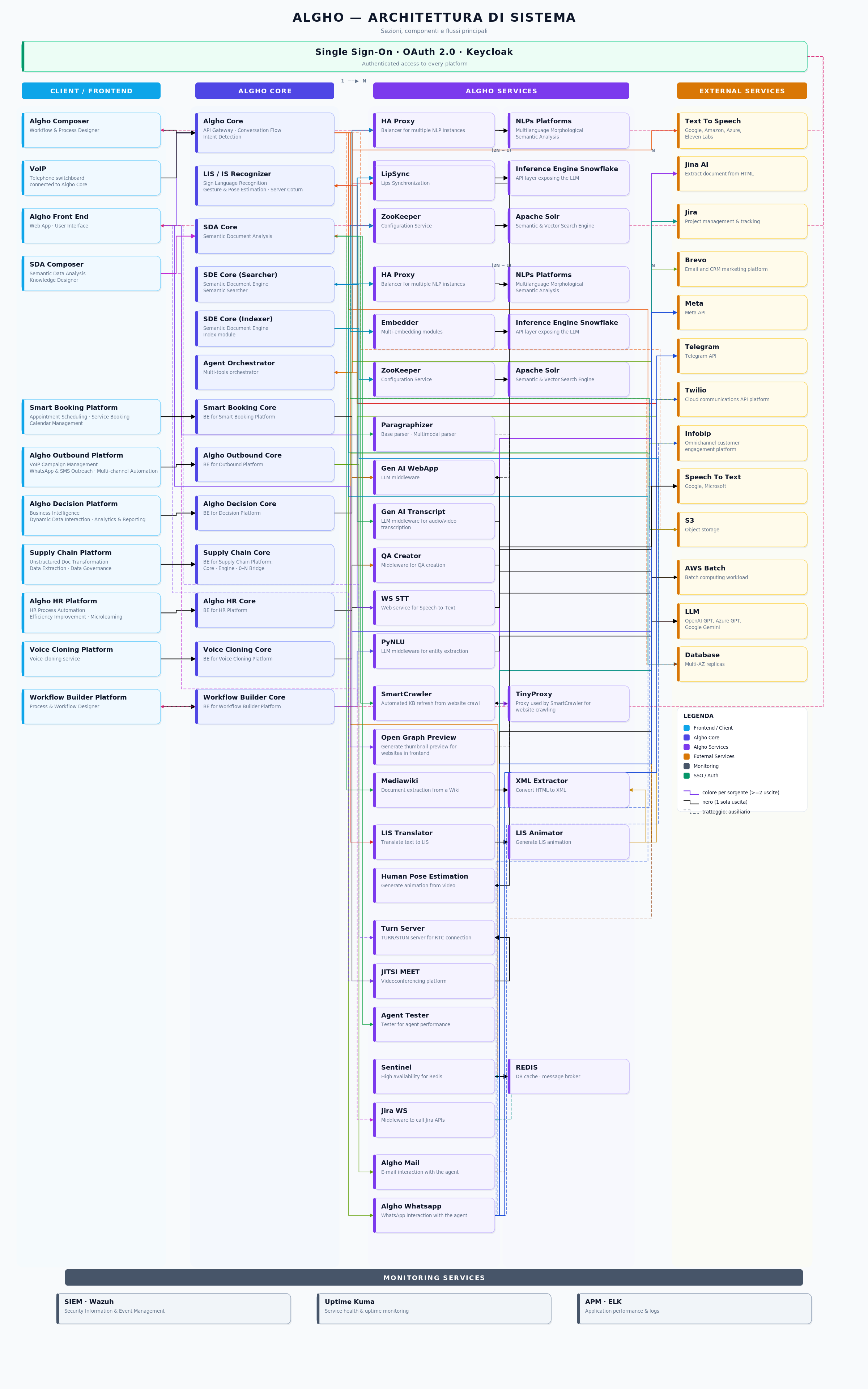
Figure 2 — Algho reference architecture: client, core, external services.
4.1.3 Platform Software Components
The Algho stack is composed of mandatory modules — required for any deployment — and optional modules that are activated based on the customer feature set. The following table reflects the component inventory derived from production deployments and the public Architecture Overview.
Channel modules (user-facing)
| Module | Purpose |
|---|---|
| Digital Human Agent (Plus) | Virtual agent with animated 3D avatar; text and voice interaction over Web and Kiosk channels. |
| Voice Agent | Voice-only agent for Web channels; integrates with TTS/STT providers. |
| Text Agent | Text agent for Web and social channels. |
| VoIP | Telephone switchboard connected to Algho Core via a dedicated Web Service; requires Google TTS keys. |
| POP/IMAP read, SMTP send; e-mail interaction with the agent. | |
| WhatsApp Business via Twilio or InfoBip number; configured through a per-customer Web Service. | |
| Telegram | Customer-created Telegram bot bound to the Algho agent. |
| Messenger | Facebook Messenger integration. |
| LIS / IS Avatar | Italian Sign Language and International Sign avatar; requires Agent Plus and GPU on-prem. |
Mandatory internal modules
| Module | Purpose |
|---|---|
| Algho Core (Backend) | Heart of the platform: API gateway, conversation orchestrator, tenant isolation, audit logging. |
| Algho Frontend | Conversational front-end used by Algho for agent interaction. |
| Algho Composer | Administrative UI for agent and knowledge base management. |
| Database (MariaDB/MySQL) | Transactional RDBMS for Algho and SDA data and configuration. |
| NLPP Multilanguages for Algho Core | Proprietary Natural Language Processing Platform performing semantic analysis on every interaction. |
| Embedder modules | Vector encoders feeding the hybrid (semantic + vector) search pipeline. |
| Mixed Documental Searcher (Solr-based) | Full-text and vector search engine over the agent knowledge base. |
| Coordination Service (Zookeeper) | Distributed coordination for the search engine cluster. |
Optional internal modules
| Module | Purpose |
|---|---|
| Smart Document Access (SDA) | RAG engine over document corpora; document pre-processing and query construction. |
| SDA Composer | Administrative UI for document corpora and subcorpora. |
| SDA search engine and coordination layer | Search engine and coordination layer dedicated to SDA. |
| SDE (Semantic Document Engine) | NLP and vector embedding pipeline over extracted paragraphs. |
| NLPP Multilanguages for SDA | Semantic analysis on SDA-driven interactions. |
| MinIO (S3-compatible) | Object storage for documents, media and artefacts used by Algho and SDA. |
| HAProxy for NLPP | Load balancer for multi-instance NLPP deployments. |
| Text-to-Speech / Speech-to-Text | Voice synthesis and recognition (local or cloud). |
| Algho Lipsync | Real-time animation engine for DHI lip-synchronisation. |
| SSO | Single Sign-On between Algho modules. |
| LLM Middleware | Bridge between Algho and the LLM inference layer. |
| Inference Engine | API layer exposing the underlying LLM. |
| Workflow Builder | Low-code workflow engine for automations and integrations. |
| Advanced Document Parser | Document segmentation and table extraction. |
| DocUMENT Parser | Identifies document cards and extracts their metadata. |
| Uptime Kuma / Grafana / Apache Proxy | Observability, logging and reverse-proxy stack. |
4.1.4 Technologies
The platform is implemented with a polyglot but consistent technology stack. The choice reflects performance requirements, ecosystem maturity and integration with the AI tooling community.
- Backend (business logic and Java services) — Java 17 for Algho Core, SDA, NLPP and OAuth2 components. Spring-based service framework, persistence layer, REST and WebSocket endpoints.
- Backend (AI services) — Python for the AI runtime: TTS, STT, Lipsync, Embedder modules, Agent Framework, LLM Middleware, Information Extraction services.
- Frontend — HTML / CSS / native JavaScript with jQuery and Bootstrap for the administrative UI; VueJS for the conversational interface (algho-viewer).
- Containerisation — every service is delivered as a Docker container, simplifying environment consistency and update procedures.
- AI models — LLaMA family (multiple sizes), Snowflake-Arctic embedder, OpenAI Whisper for speech-to-text, NVIDIA Nemo-retriever-parser for document and table parsing.
4.1.5 Commercial Off-The-Shelf (COTS) Components
| COTS | Use within Algho |
|---|---|
| Apache Solr | Full-text and vector search engine underlying the Mixed Documental Searcher. |
| Redis | In-memory cache and message broker for the document parser worker. |
| Uptime Kuma | Synthetic uptime and latency monitoring with status pages. |
| MinIO | S3-compatible object storage for files, backups and artefacts. |
| HAProxy | Layer 4/7 load balancing with TLS termination, sticky sessions and rate limiting. |
| Apache HTTP Server | Reverse proxy for HTTPS termination on selected domains. |
4.2 Deployment
4.2.1 Supported Deployment Models
Algho is available in three deployment models: SaaS on Cloud, On-Premise and Appliance. The choice of model is driven by data residency, regulatory constraints, latency requirements and the customer preference for managed versus self-operated infrastructure. Each model carries a distinct security boundary, ownership profile, maintenance posture and target audience.
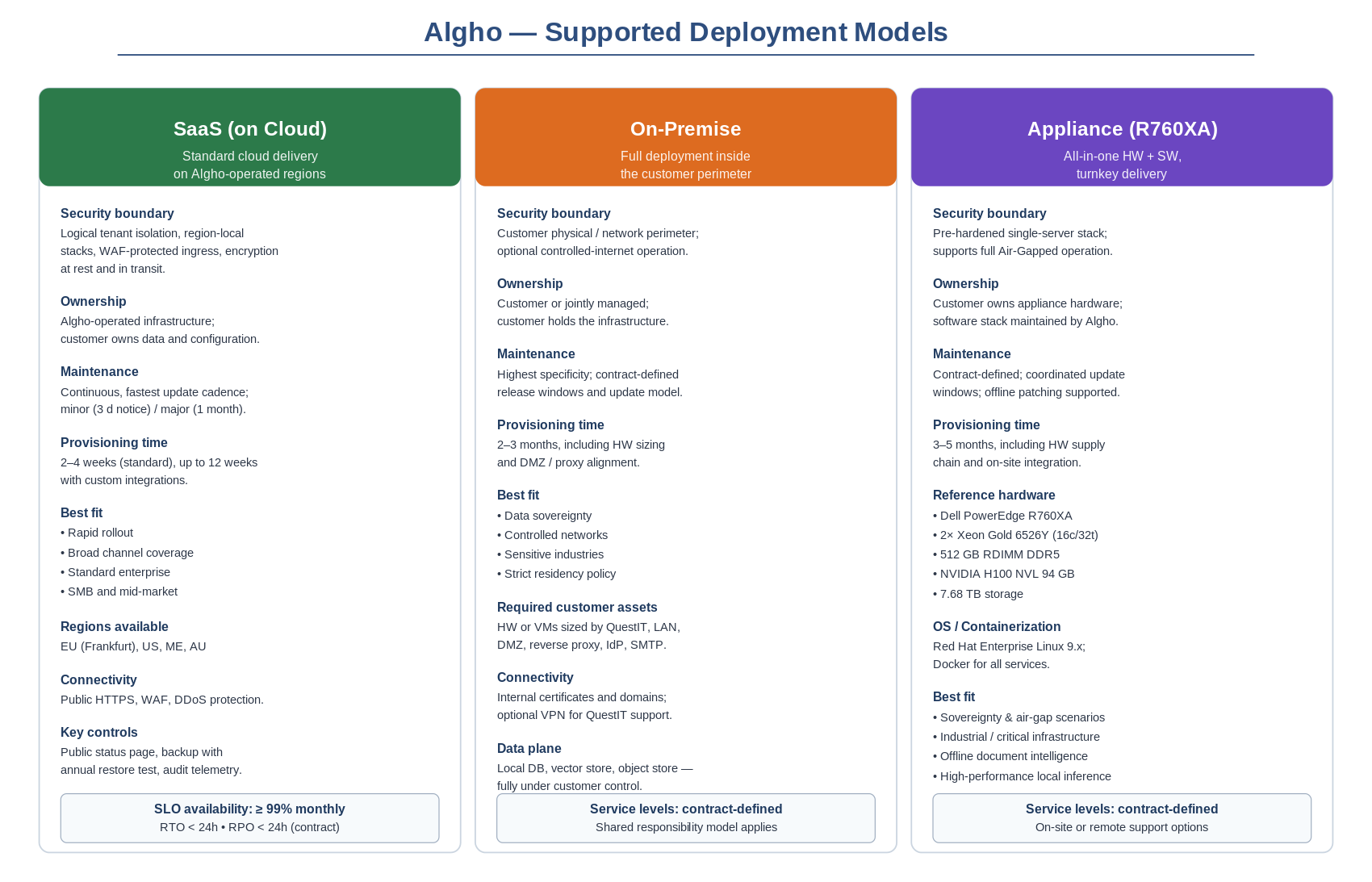
Figure 3 — Supported deployment models: SaaS on Cloud, On-Premise, Appliance.
| Model | Security boundary | Maintenance | Provisioning | Best fit |
|---|---|---|---|---|
| SaaS (on Cloud) | Logical tenant isolation, region-local | Algho-operated, fastest update cadence | 2–4 weeks | Standard enterprise, broad channel coverage, rapid rollout |
| On-Premise | Customer physical / network perimeter | Customer or jointly managed, contract-defined updates | 2–3 months | Data sovereignty, controlled networks, sector-specific compliance |
| Appliance (R760XA) | Single pre-hardened server, optional air-gapped | Contract-defined; offline patching supported | 3–5 months | Sovereignty, air-gap scenarios, high-performance local inference |
4.2.2 SaaS on Cloud
In the SaaS model, customers access the platform through region-local entry points (WAF + API ingress) deployed per geography. Validated traffic is routed within the corresponding SaaS VPC hosting the application services. Asynchronous workloads are offloaded to queue- and event-driven processors, while persistent content is maintained in object and document storage. Operational telemetry — logs, metrics, traces — is centralised. Tenant isolation is logical and policy-enforced, and all data-plane components remain confined to the local region.
4.2.3 On-Premise
For organisations requiring total infrastructure ownership, Algho is delivered as a fully deconstructed on-premise installation. In this model the architecture and the sizing of the solution are defined jointly between the parties on a project-by-project basis, in line with the customer requirements, IT topology and operational constraints. The internal network architecture and the distribution of Algho core services — including the application subnet, local database and local vector store — are shared transparently with the customer, so that DMZ configuration, reverse-proxy rules and data-subnet segmentation can be aligned with internal security and compliance standards. Connectivity can be hardened through one-way bridges or VPNs.
4.2.4 Appliance (Dell PowerEdge R760XA)
The Appliance variant is a turnkey, highly integrated solution where the entire Algho stack is pre-configured within a single hardened server. The internal architecture is defined and integrated within the appliance to ensure optimal performance and stability, while the external interconnection strategy is developed in close coordination with the customer to integrate with local observability and syslog. For high-security environments the Appliance supports a full Air-Gapped operation option, providing a completely isolated intelligence layer that operates without any external links.
When the Appliance is deployed in a fully Air-Gapped configuration with no network access, all external services normally consumed by Algho are replaced by analogous components installed locally on the appliance server. The following substitutions apply:
- Text-To-Speech: XTTS v2 (local speech synthesis engine replacing external TTS providers).
- Speech-To-Text: Whisper (on-device transcription model replacing external STT providers).
- AWS S3: MinIO (S3-compatible object storage running locally on the appliance).
- LLM (GPT, Gemini): Google Gemma 4 and LLAMA 70B, served locally on the appliance GPUs to replace external LLM providers.
Conversely, when no form of network access is available, the following services cannot operate and the related capabilities are not delivered in an Air-Gapped Appliance deployment:
- WhatsApp (Twilio, InfoBip).
- algho outbound.
- Jina AI.
- Jira.
- Brevo.
- AWS Batch.
- Telegram.
- Voice Cloning Platform.
The resulting service architecture for the Appliance deployment is illustrated in the diagram below, which highlights the local components and the substitutions with respect to the standard deployment.
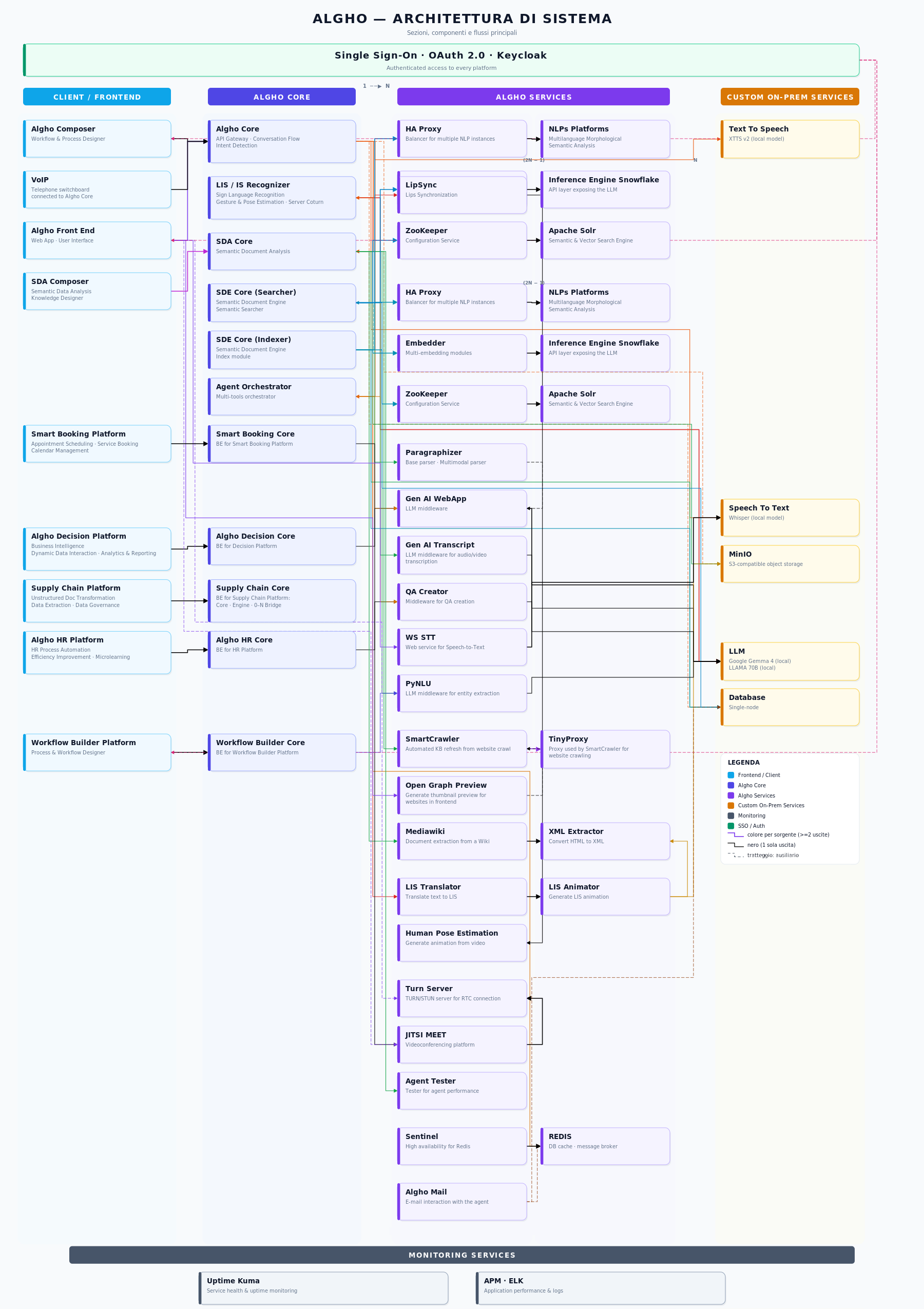
The modules actually installed on the appliance depend on the project type and on the customer requirements: not all of them need to be deployed, and the final configuration is defined during the analysis phase based on the functionalities required.
4.2.5 Regional Strategy (Cloud)
Algho follows a region-first segregation strategy: customer data, retrieval corpora, keys, backups and audit exports remain region-local unless a contract, legal basis and disaster-recovery policy explicitly allow controlled movement. The current primary EU region is eu-central-1 (Frankfurt); US, Middle East and Australia regions are available for customers with the corresponding sovereignty or latency requirements. Data residency is explicit by geography, and a regional mapping table is shared during procurement.
| Customer geography | Primary region | Residency note |
|---|---|---|
| EU | eu-central-1 (Frankfurt) | Production data remains in EU unless contractually approved transfer. |
| US | us-east-1 | Production data remains in US geography unless contract states otherwise. |
| Middle East | me-central-1 | Local region used where sovereignty, latency or public-sector requirements apply. |
| Australia | ap-southeast-2 | Local region used where sovereignty, latency or public-sector requirements apply. |
4.3 Hardware and Software Requirements
4.3.1 Reference Appliance Sizing (R760XA)
The configuration below is the reference sizing of the Appliance and is intended to give a quantitative idea of the resources allocated to a typical project. The actual resources of the server may vary depending on the customer requirements: in the initial project phase the sizing is reviewed against expected concurrency, language coverage, corpus volume, presence of GPU-bound modules and high-availability targets, and adjusted accordingly. The reference configuration is built on Dell technologies.
| Component | Specification (reference) |
|---|---|
| Server | Dell PowerEdge R760XA |
| CPU | 2× Intel Xeon Gold 6526Y — 16 cores / 32 threads each, Hyper-Threading, Turbo, 195 W TDP, DDR5-5200 |
| RAM | 16× RDIMM 32 GB (total 512 GB) |
| GPU | NVIDIA H100 NVL 94 GB, double-wide, optimised for AI and deep-learning workloads |
| Storage | 7.68 TB |
| Power Supply | Hot-plug PSU 2800 W, Titanium efficiency |
| Operating System | Red Hat Enterprise Linux 9.x (e.g., 9.6 Plow) |
4.3.2 On-Premise Sizing (Project-Dependent)
On-premise sizing is intentionally not fixed in this document: the dimensioning of the solution is assessed during the project phase, after a structured collection of the customer requirements. The following factors are the main drivers of variability and are the primary inputs to the sizing exercise:
- Number of environments to be provisioned (development, test, staging, production, disaster recovery).
- High-availability mode chosen — single-node, active/passive, active/active, multi-region — and the related redundancy of stateful components.
- Algho modules to be installed — core platform, SDA, NLPP languages, Workflow Builder, Lipsync, LIS / IS avatar, voice channels, etc.
- External services to be integrated — ERP, CRM, ticketing, identity providers, observability and SIEM stacks.
- Possibility of using external services for AI capabilities such as TTS, STT, embeddings or LLM, which moves part of the compute footprint outside of the on-premise stack.
- Possibility of using provider-managed services where the deployment is hosted on a private cloud or on a customer-controlled cloud subscription rather than on bare-metal infrastructure.
4.3.3 Cloud / SaaS Requirements
- Internet connectivity from end-user devices.
- Modern browser (ChromE, Firefox, Safari, Edge).
- Optional VPN or PrivateLink for private connectivity scenarios.
4.4 Integrations and APIs
4.4.1 Algho Public APIs — Overview
Algho exposes a coherent family of REST and WebSocket APIs. Full public documentation, with request/response payloads and authentication details, is available at:
The main API families are:
- Conversational API — agent metadata retrieval, conversation history, message exchange, engagement triggers, voting.
- Knowledge Base Web Service — server-side callback for answer enrichment and override.
- Forms API and Dynamic Forms API — schema-driven data capture with admissible values resolved at runtime.
- External Engine API — customer-side logic and action extension points.
- Voting / Engagement endpoints — upvote, downvote and proactive engagement prompts on idle conversations.
4.4.2 OpenAPI Reference
A formal OpenAPI 3.2.0 baseline is maintained as part of the Architecture Overview. Representative endpoints include:
| Endpoint | Purpose |
|---|---|
| GET /bot/{botId} | Retrieve agent metadata and channel configuration. |
| GET /conversate_item/list | Retrieve conversation history. |
| POST /conversate_item/send_message | Send a user message and receive the answer payload, optionally with TTS and lipSync. |
| POST /engagement/conversation/{conversationId} | Request an engagement prompt for idle conversations. |
| POST /qa/upvote | Upvote an answer. |
| POST /qa/downvote | Downvote an answer. |
4.4.3 Integration Patterns
Algho supports five complementary integration patterns. Customers typically combine them based on the maturity of their integration stack and the depth of automation required.
- Conversational API integration — server-to-server invocation of the public API.
- Forms and Web Service integration — callback-driven validation and data exchange.
- External Engine integration — custom logic externalised to a customer-managed engine for selected intents.
- Webhook and Queue/Event integration — asynchronous fabric for long-running and event-driven workloads.
- Embedded script (algho-viewer) — browser-side widget integration with context propagation through token, ajwt, user-id, context and applicationContext.
4.4.4 Authentication and Trust Model
The recommended enterprise authentication model combines three layers:
- OAuth 2.0 client credentials or equivalent machine-to-machine pattern for enterprise integrations.
- JWT-signed context where lightweight token carriage is needed (token, ajwt headers).
4.4.5 Pre-Built Connector Catalogue
Algho ships with hundreds of pre-built connectors maintained as part of the Workflow Builder catalogue. The categories below are indicative; the full list is published and continuously updated on www.docs.alghoncloud.com.
| Category | Representative connectors |
|---|---|
| ERP | SAP, Microsoft Dynamics, Oracle E-Business Suite, NetSuite. |
| CRM | Salesforce, HubSpot, Microsoft Dynamics 365, Zoho CRM. |
| Ticketing / ITSM | Zendesk, Jira Service Management, ServiceNow, Freshdesk. |
| Databases | PostgreSQL, MySQL, Microsoft SQL Server, Oracle, MongoDB. |
| Messaging | WhatsApp (Twilio, InfoBip), Telegram, Facebook Messenger, Microsoft Teams, Slack. |
| Calendars and scheduling | Google Calendar, Microsoft Outlook / Exchange, Calendly. |
| Identity Providers | Keycloak, Azure AD / Entra ID, Okta, Auth0. |
| Email and productivity | Microsoft 365, Google Workspace, IMAP / SMTP generic. |
| E-commerce | Shopify, WooCommerce, Magento, PrestaShop. |
| Storage and content | S3-compatible, MinIO, Google Drive, SharePoint, OneDrive. |
4.4.6 Bundles Catalogue
In addition to point connectors, Algho exposes a Bundles catalogue: more than 200 enterprise functions are pre-mapped to ready-to-use workflows. Activation typically requires only the insertion of customer-specific keys (CRM, ERP, ticketing) and minimal field mapping, allowing rollouts in days rather than weeks. The bundles complement the four vertical platforms described in Section 2.13 (Decision, Supply Chain, XR, Sales Assistant).
The information presented in this chapter is a synthetic description of the integration model. Full and continuously updated technical references — API contracts, schemas, payload examples and integration tutorials — are published on the public documentation portal at www.docs.alghoncloud.com.
5. Security, Compliance and Policies
All information related to Algho security posture and data governance is consolidated and continuously maintained on the public Algho Trust Portal, accessible directly from the Algho website at https://www.alghoncloud.com/trust-portal/
The Trust Portal is the authoritative public reference for procurement, due-diligence and security-review activities and complements the present Product Sheet with the latest evidence and documentation.
5.1 Trust Portal — Public Reference
The Algho Trust Portal centralises the security and compliance documentation that supports customer due diligence. It typically includes:
- Posture summary covering Security by Design and Privacy by Default principles applied across all deployment models.
- Compliance positioning with respect to GDPR, the EU AI Act and the relevant ISO families.
- Catalogue of available certifications and attestations, with downloadable evidence where applicable.
- Data residency and regional strategy, with the list of supported regions and the corresponding lawful-basis framework.
- Encryption, key-management and secrets-handling controls (at rest and in transit).
- Identity, access management and RBAC model, including SSO and external IdP federation patterns.
- Logging, monitoring and SIEM-readiness, with a description of the telemetry surface exported to customer SOCs.
- AI safety and governance controls — model inventory, prompt-injection defences, tool allowlisting, human-oversight matrix.
- Operational transparency artefacts — public status page, uptime history, incident communication policy.
- Shared responsibility model for each deployment option (SaaS, On-Premise, Appliance).
Customers and partners are invited to consult the Trust Portal as the single source of truth for the current state of Algho security and data-governance posture. The portal is updated by QuestIT in line with platform evolutions, certification renewals and new regulatory requirements.
5.2 Document Cross-Reference
The Product Sheet remains aligned with the Trust Portal: where the Trust Portal exposes a specific control or attestation, that control is also referenced in the relevant chapter of this document.
6. SLA and Support Policies
The Service Level Objectives, support procedures and warranty terms applicable to Algho are formally defined in the QuestIT General Terms and Conditions and in the specific contract executed with each customer. The contractual document prevails in case of inconsistency with the summary provided here.
6.1 Cloud Service Availability
For Algho cloud services, QuestIT warrants a minimum monthly availability of 99%, calculated as the percentage of time during the reference month in which the service is accessible and usable by the customer. Catastrophic events that trigger the Disaster Recovery procedure, as well as the exclusions described below, are removed from the calculation basis.
6.2 Emergency Support and Critical Incident Response
Emergency technical support is guaranteed 24 hours a day, 7 days a week, throughout the year. For incidents with critical impact on the customer operations, QuestIT guarantees a maximum response time of one hour, measured as the interval between the incident notification and the takeover by the QuestIT support team. The response time refers to the takeover and does not represent the resolution time, which depends on the complexity of the incident.
6.3 Maintenance Classification
Maintenance requests are classified by severity. The following table summarises the contractual takeover and resolution targets, expressed in working hours (Monday to Friday, 09:00–18:00).
| Severity | Description | Takeover | Resolution |
|---|---|---|---|
| Blocking | Total impossibility to access or use the product or service. | 6 working hours | 8 working hours |
| Severe | Strongly limited use involving essential functionalities. | 6 working hours | 16 working hours |
| Medium | Reduced use or ancillary functionalities affected. | 6 working hours | 40 working hours |
| Minor | Limited impact or slowdown without significant impairment. | 6 working hours | 80 working hours |
Where the complexity of the issue requires longer resolution, QuestIT communicates an estimated timeframe to the customer and, where feasible, suggests temporary workarounds. If a workaround materially reduces the operational impact, the issue may be reclassified accordingly.
6.4 Release Communication
Minor Releases — primarily bug fixes and backward-compatible new features — are communicated with at least three days of notice, accompanied by release notes. Major Releases — changes involving substantial functional evolution — are communicated with at least one month of notice, also accompanied by release notes.
6.5 Backup Restore Testing
QuestIT performs at least one annual test of the backup restoration procedure, providing evidence of execution as part of the operational assurance package.
6.6 Availability Exclusions
The availability warranty does not apply where service disruption is caused by force majeure or unforeseeable events; catastrophic events triggering Disaster Recovery; customer or end-user misuse; suspension for non-payment; customer or third-party connectivity issues; malfunction or inadequacy of the customer hardware, software or infrastructure; or problems originating from third-party integrations outside QuestIT responsibility.
6.7 Penalties and Service Credits
Failure to meet the minimum cloud service availability level entails a contractual penalty in the form of a reduction of the annual fee, proportionate to the percentage of availability not achieved. The specific calculation method, eligibility conditions and claim process are governed by the executed customer contract.
6.8 Insurance Coverage
In support of the operational and contractual commitments described above, QuestIT maintains an active professional liability insurance policy underwritten by AXA Assicurazioni S.p.A., dedicated to IT Consultants / Software Houses, with unlimited retroactivity. This coverage extends the protection available to enterprise customers and partners engaged in multi-year technology programmes.
6.9 Contractual Reference
The information above is a summary of the relevant sections of the QuestIT General Terms and Conditions 2026 — in particular Article 9 on uptime and service levels and Article 11 on liability — and of the related Architecture Overview. The executed customer contract, order form and applicable service schedule remain the authoritative documents for SLA and support terms.
7. Certifications and Recognitions
This chapter summarises the certifications, regulatory acknowledgements and partnerships that underpin Algho and QuestIT.
7.1 Algho — Compliance, Public Sector and Marketplace Presence
The following items refer specifically to the Algho platform:
- GDPR compliance — the platform is designed under Privacy by Default and Privacy by Design principles, with data-protection considerations integrated into architecture, integrations, retention policies and operational procedures.
- ACN national register for Public Administration — Algho is registered with the Italian Cybersecurity Agency (ACN) national catalogue, enabling adoption by Italian Public Administration entities in line with the corresponding qualification framework.
- AWS Marketplace — the Algho solution is published on the AWS Marketplace, simplifying procurement and deployment for AWS customers worldwide.
- Microsoft Azure Marketplace — the Algho solution is also published on the Microsoft Azure Marketplace, enabling streamlined procurement and deployment for Azure customers.
7.2 QuestIT — Corporate Certifications
The following certifications are held by QuestIT and apply to the way the company designs, develops and delivers its products, including Algho:
- ISO 9001 — Quality Management System.
- ISO 14001 — Environmental Management System.
- ISO 45001 — Occupational Health and Safety Management System.
- ISO 27001 / 27017 / 27018 — Information Security Management System, with specific extensions for cloud-service security (27017) and protection of Personally Identifiable Information in public clouds (27018).
- UNI/PdR 125:2022 — Gender Equality Management System, formal recognition of the company practices on equal opportunities and diversity in the workplace.
7.3 Technology Partnerships
- Hardware: Dell Technologies (partner for the Appliance R760XA platform by JMC Group, a Vection Technologies company).
- GPU: NVIDIA (H100 NVL and NVIDIA Nemo AI modules).
- Cloud: AWS and Microsoft Azure (marketplace presence, region-aware deployments, alignment with Well-Architected Framework guidelines).
8. Appendix A - Glossary and Acronyms
The following table lists the acronyms and key terms used across the Product Sheet, with a concise definition. It is intended as a quick reference for procurement, technical and security stakeholders.
| Acronym | Definition |
|---|---|
| AJWT | Algho JSON Web Token — proprietary signed token carried in the Authorization header to propagate identity and context between the client integration and the Algho core. |
| API | Application Programming Interface — contract exposed by a software component to enable programmatic interaction. |
| BI | Business Intelligence — set of tools and processes for the analysis of business data. |
| COTS | Commercial Off-The-Shelf — ready-made software products integrated into the platform stack. |
| CRM | Customer Relationship Management — system of record for accounts, contacts, opportunities and customer interactions. |
| DBMS | Database Management System — software responsible for storing, retrieving and managing structured data. |
| DHI | Digital Human Interface — Algho 3D avatar layer, animated in real time with lip-synchronisation. |
| DR | Disaster Recovery — set of procedures aimed at restoring service after a catastrophic event. |
| ERP | Enterprise Resource Planning — integrated system covering finance, supply chain, manufacturing and other core business functions. |
| GDPR | General Data Protection Regulation — EU regulation 2016/679 on personal data protection. |
| HSM | Hardware Security Module — dedicated cryptographic device used for key generation and protection. |
| IAM | Identity and Access Management — set of policies and tools governing who can access which resources. |
| IDP | Intelligent Document Processing — set of capabilities for ingestion, parsing and extraction of structured data from documents. |
| IdP | Identity Provider — system responsible for authenticating users (e.g., Keycloak, Azure AD). |
| IS | International Sign — auxiliary signed language used in cross-border deaf communication. |
| KB | Knowledge Base — structured collection of intents, answers, documents and metadata used by an agent. |
| KMS | Key Management Service — service responsible for the lifecycle of cryptographic keys. |
| LIS | Lingua Italiana dei Segni — Italian Sign Language. |
| LLM | Large Language Model — generative AI model trained on massive textual corpora. |
| MFA | Multi-Factor Authentication — authentication requiring two or more independent factors. |
| MCP | Model Context Protocol — open protocol for exposing tools, data and capabilities to AI agents. |
| NLPP | Natural Language Processing Platform — proprietary QuestIT linguistic engine for semantic analysis. |
| OCR / ICR | Optical / Intelligent Character Recognition — extraction of typed and handwritten text from images and documents. |
| RAG | Retrieval-Augmented Generation — pattern combining retrieval over a curated corpus with LLM generation. |
| RBAC | Role-Based Access Control — authorisation model where permissions are assigned to roles. |
| RPO | Recovery Point Objective — maximum acceptable amount of data loss measured in time. |
| RTO | Recovery Time Objective — maximum acceptable time to restore service after disruption. |
| SaaS | Software as a Service — cloud-delivered software accessed over the network. |
| SDA | Smart Document Access — Algho enterprise-grade RAG subsystem. |
| SDE | Semantic Document Engine — Algho NLP and vector-embedding pipeline over extracted paragraphs. |
| SIEM | Security Information and Event Management — platform that aggregates and correlates security telemetry. |
| SLA | Service Level Agreement — contractual document describing commitments on service quality. |
| SLO | Service Level Objective — measurable target for a specific service metric (e.g., availability). |
| SSO | Single Sign-On — authentication scheme where one login grants access to multiple systems. |
| STT | Speech-to-Text — automatic transcription of audio into written text. |
| TLS | Transport Layer Security — protocol for secure communication over a network. |
| TTS | Text-to-Speech — synthesis of audio from a written text. |
| VPC | Virtual Private Cloud — logically isolated network within a public cloud provider. |
| WAF | Web Application Firewall — security control protecting web applications from common attacks. |
| XR | Extended Reality — umbrella term covering augmented, virtual and mixed reality. |
9. Appendix B — Contacts
- Website — www.alghoncloud.com / www.quest-it.com
- Customer Care — customercare@quest-it.com
- Headquarters — QuestIT s.r.l., Via Leonida Cialfi 23, 53100 Siena, Italy
- Operational office — Via Donato Castellana 2, 70023 Gioia del Colle (BA), Italy
- Phone — +39 0577 533902
- PEC — questit@pec.quest-it.com
- Info — info@quest-it.com